"Have you heard people referring to the Cincinnati Streetcar as a “trolley?” It’s a dated and inaccurate term. Here’s why:"
Thursday, January 30, 2014
Transit terminology pop quiz: "streetcar" v. "trolley"
Random, but I found this post / infographic on CincyStreetcar Blog hilarious for some reason. I've heard the two terms confused so. many. times!

Tuesday, January 28, 2014
Transportation disaster in Atlanta: how the region's car-centric urbanism is at fault
As a winter storm moves across the South (including here in normally sunny North Carolina) the worst-case-scenario gridlock event that is unfolding in Atlanta this evening shows off a major problem of Atlanta's sprawly urban form. Reports are pouring in of commuters stuck on the icy highways without a place to go, many of them miles upon miles from home. Some have resorted to walking for many hours just to get off the highway.
(Note: Although car-centric cities always have difficulty with adjusting to major winter events, the fact that this is taking place in the deep South adds to the craziness: Atlanta just isn't used to these types of events.)
Now, would Atlanta be having this same level of commuter chaos if the metro area was designed in a more organic, people-focused way? Would this amount of gridlock even take place if the Atlanta region had an effective rail and transit system? (MARTA ain't enough, folks).
I mean, really. Should a couple of inches of snow really be enough to shut down a metropolitan area of 6 million people, and even place some poor souls into life-threatening situations? No, it shouldn't. And yes, I definitely believe that the DOT down there has done a particularly awful job at handling this storm... but I think it's stupid to deny that Atlanta's sprawltacular "urban" form plays a key role in all of this.
Hundreds of thousands of people commute to and from work by the Atlanta highway system. Most of these commutes are at least 30 minutes without traffic. Of course this isn't breaking news; people across the country live far from work (at distances that would be unimaginable before the advent of the automobile). This isn't inherently wrong, either. But the Atlanta area is so car-centric that people are literally stranded without it. Tonight is just more proof of that.
(Note: Although car-centric cities always have difficulty with adjusting to major winter events, the fact that this is taking place in the deep South adds to the craziness: Atlanta just isn't used to these types of events.)
Now, would Atlanta be having this same level of commuter chaos if the metro area was designed in a more organic, people-focused way? Would this amount of gridlock even take place if the Atlanta region had an effective rail and transit system? (MARTA ain't enough, folks).
I mean, really. Should a couple of inches of snow really be enough to shut down a metropolitan area of 6 million people, and even place some poor souls into life-threatening situations? No, it shouldn't. And yes, I definitely believe that the DOT down there has done a particularly awful job at handling this storm... but I think it's stupid to deny that Atlanta's sprawltacular "urban" form plays a key role in all of this.
Hundreds of thousands of people commute to and from work by the Atlanta highway system. Most of these commutes are at least 30 minutes without traffic. Of course this isn't breaking news; people across the country live far from work (at distances that would be unimaginable before the advent of the automobile). This isn't inherently wrong, either. But the Atlanta area is so car-centric that people are literally stranded without it. Tonight is just more proof of that.
Friday, January 3, 2014
Just a quick post to kick off the New Year

This model of ancient Rome is a perfect example of how a traditional city looks from above;
- Maximum building coverage coupled w/ really narrow (i.e. people scaled) streets
- Little to no pointless "green space," but plenty of interior courtyards and gardens
- Numerous plazas, markets, and other public spaces
Thursday, December 19, 2013
Recommended reading: Nevada City and architectural theory
Back in September, this piece was posted over at Uncouth Reflections. The writer calls the gold rush town of Nevada City, California, an "architecture-and-urbanism masterpiece" and uses photos from his trip there to develop some "hunches" about architecture and urban design in general:
I recommend reading through the entire article; it is full of great photos as well as urbanism common sense.
"Some more hunches about what might result in humane and pleasing built environments: Approach building and development as an outgrowth and refinement of nature. Work with the actual environment, not against it. Make generous use of local materials. Value pluralism and variety, yes, but value harmony and simple, direct human pleasures even more. Perhaps, 99% of the time, fitting in is more important than standing out. Value the roughshod, the approachable, the informal and the ramshackle more than the impersonal, the awe-inspiring and the perfect."
I recommend reading through the entire article; it is full of great photos as well as urbanism common sense.
Friday, December 6, 2013
"Union Way" in Portland, Oregon
Union Way is a very cool little project that opened this past summer in Portland. It feels like and functions as an outdoor pedestrian street, when in fact it actually cuts down the spine of a massive old garage building. One of Union Way's developers noted that the project "takes its inspiration from small shop-lined alleys and passageways of old in cities like Paris and Tokyo." Here's an interesting short article about the "arcade-like space" I stumbled upon this evening. A snippet:
“Essentially the Red Cap Garage is this long, deep, narrow building. It’s 47 feet wide and about 135 feet deep. The problem that you have is that only 47 feet has street frontage. So this space deep in here begins to be dark. The question becomes: how do you monetize that? How do you make that valuable? How do you make that interesting? The answer was to add a new street.”
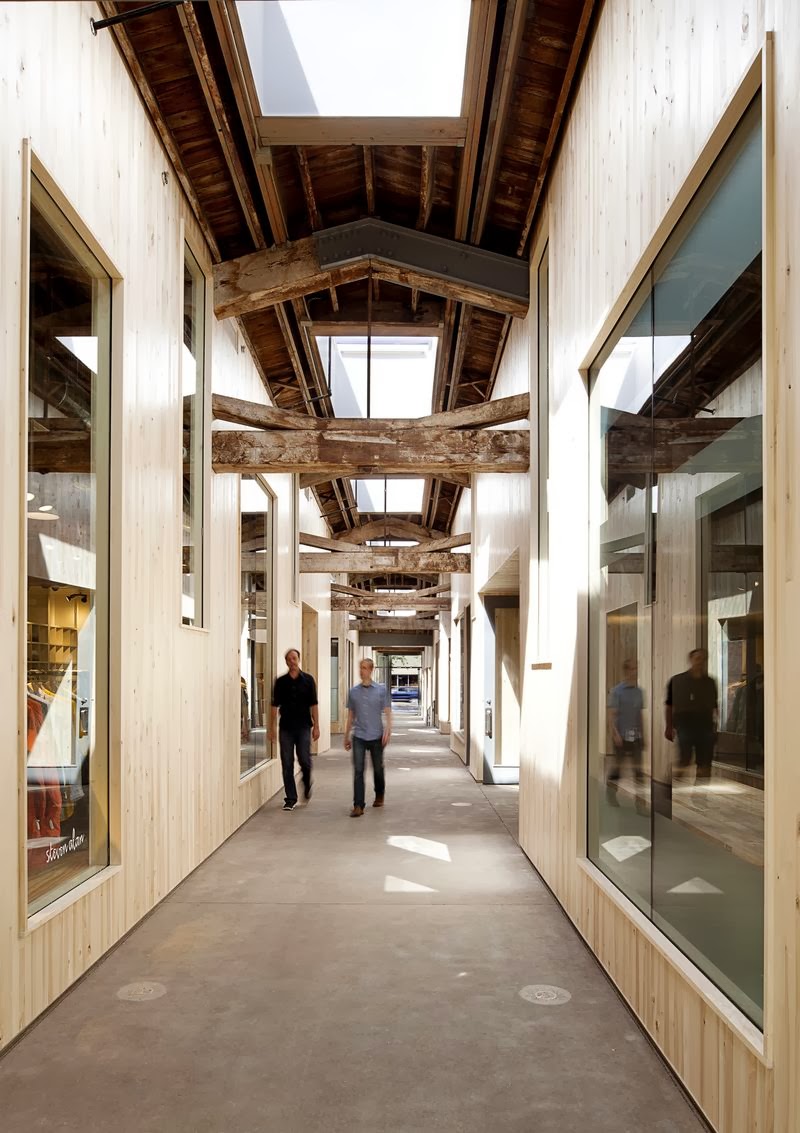
Union Way (photo by Jeremy Bittermann)
Subscribe to:
Posts (Atom)