Showing posts with label traditional city. Show all posts

Saturday, July 18, 2015

Narrow Isn't Enough (Kill the Curb!)

(this is how to do it)

In this addition to his Traditional City series, Nathan Lewis elaborates on how simply having a narrow street isn't enough to create a successful place designed for people. The existence of significant curbs on many narrow streets around the world delegates a separate place for cars and a separate place for people, even inadvertently. Read on!

Narrow Streets for People 4: Organizing the Street

Tuesday, August 19, 2014

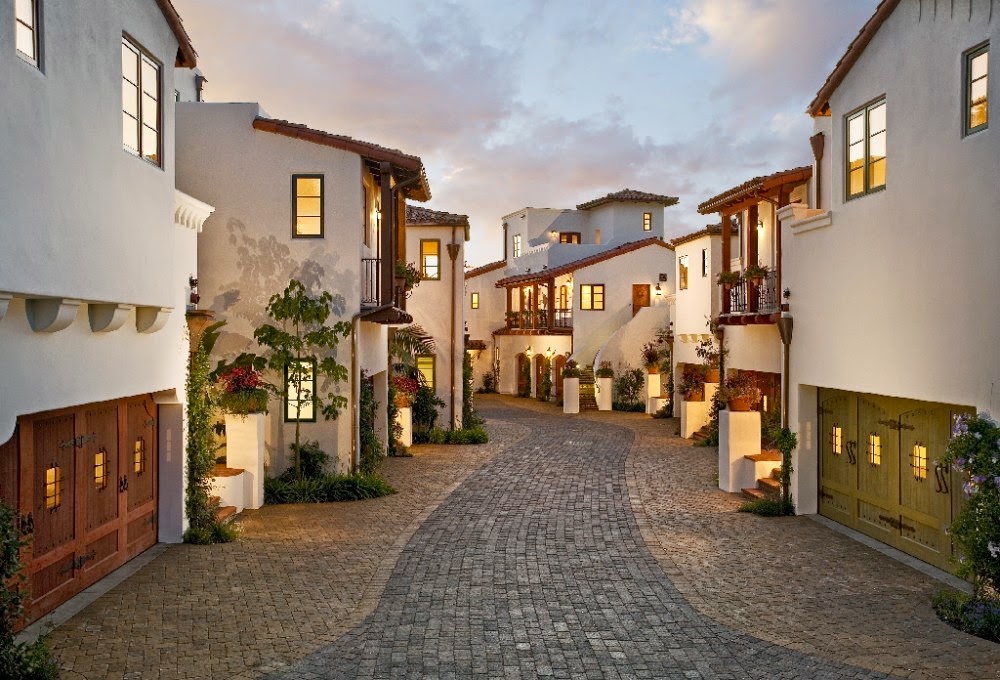
A new development built in the traditional style!


Sure, it's located in the midst of the sprawliness of outer Santa Barbara, but it's a start! Las Palmas Viejas is a small development of several "villas" off a highway west of downtown Santa Barbara. The designers involved in this project did a fine job incorporating garage doors & an even better job at the design of the "street" (which is effectively a cul-de-sac). Notice how there is no separation of sidewalk and roadbed. A change in paving stone colour does the same job while refusing to distinguish clearly separate spaces for cars and walkers, thus calming traffic.

Even at such a small scale, it's encouraging to see developers willing to try this type of project instead of typical suburban housing or superblock "townhomes."

Friday, January 3, 2014

Just a quick post to kick off the New Year


This model of ancient Rome is a perfect example of how a traditional city looks from above;

  • Maximum building coverage coupled w/ really narrow (i.e. people scaled) streets
  • Little to no pointless "green space," but plenty of interior courtyards and gardens
  • Numerous plazas, markets, and other public spaces

Thursday, December 19, 2013

Recommended reading: Nevada City and architectural theory

Back in September, this piece was posted over at Uncouth Reflections. The writer calls the gold rush town of Nevada City, California, an "architecture-and-urbanism masterpiece" and uses photos from his trip there to develop some "hunches" about architecture and urban design in general:

"Some more hunches about what might result in humane and pleasing built environments: Approach building and development as an outgrowth and refinement of nature. Work with the actual environment, not against it. Make generous use of local materials. Value pluralism and variety, yes, but value harmony and simple, direct human pleasures even more. Perhaps, 99% of the time, fitting in is more important than standing out. Value the roughshod, the approachable, the informal and the ramshackle more than the impersonal, the awe-inspiring and the perfect." 

I recommend reading through the entire article; it is full of great photos as well as urbanism common sense.

Tuesday, November 26, 2013

True sustainability

UniverCity is a sustainable-development community located at the top of Burnaby Mountain (adjacent to Simon Fraser University) outside of Vancouver. Here is what the area looks like from above:


View Larger Map

Two things are apparent from the satellite view: an abundance of green space, and an abundance of parking space.

Saturday, November 2, 2013

Taxco, Guerrero

The relatively hidden gem of Taxco lies approximately 100 miles southwest of Mexico City. The town is known for its silver trade and irregular, winding streets.

The beautiful church of Santa Prisca is in the center of town. And, for the record, you are looking at pretty much the widest stretch of pavement in the city.


View Larger Map

Tuesday, October 29, 2013

Ciudad tradicional: A Look at San Luis Potosí

Mexico, unlike its neighbors to the north, is filled to the brim with traditional-style cities. Most of these cities were founded during the brutal Spanish conquest, but some pre-Columbian sites remain from previous inhabitants. This is the first post in a series showing some of the wonderful pre-automobile towns that Mexico has to offer.

San Luis Potosí was founded in 1592 by miners. The city was named after the famous mining town of Potosí in modern-day Bolivia. SLP's center is home to some of the finest colonial architecture in all of Mexico.
For example...


View Larger Map

Friday, October 18, 2013

The allure of by-lanes & cobbled streets

This is an awesome page I stumbled upon today. Scroll through the pictures for a while.

Cunda, Turkey

This is what I mean by "traditional" urbanism! Life without cars is beautiful.

Wednesday, September 11, 2013

2 American Alleyways Repurposed as Narrow Streets

Tight streets (or "Really Narrow Streets" as Nathan Lewis calls them) are KEY in any successful urban area from the smallest village to a Tokyo-size megalopolis. I would say they are the most important part of what makes a great city (a city for people, not cars). Unfortunately, American cities have a noticeable lack of them outside of places founded in the colonial era like Boston and New Orleans. However, there are numerous examples of American cities sprucing up their alleyways, and the finished result is very similar to a Really Narrow Street. Here are two of those examples.

1. Will Dodge Way, Ashland, Oregon


View Larger Map

Will Dodge Way runs on the backside of the streetwall of buildings on East Main Street in Ashland. The width between each side of the alley (building-to-building) varies from ~15-25 feet.

2. Pedestrian Alley, Holland, Michigan (photo by me)


Google Earth says that this charming spot is called "Pedestrian Alley." Kind of generic, but it does a good job of describing what I would call a narrow street. The alleyway runs between two of Holland's major downtown streets, Central and River, and behind buildings facing the always-popular 8th Street. Several businesses have entrances opening onto the alley. Most of the actual pedestrian traffic sticks to the 8th Street-facing side, though. The width of the pictured section of the alley is about ~16 feet.

Now of course an alley like this is just a tiny pedestrian oasis in what is still a car-focused town... but I thought it would be cool to point out a couple of people-sized spaces that have been developed recently.

Related links:
Here's a Curbed article on a similar plan in a fashionable neighbourhood of San Francisco.

Monday, September 9, 2013

Welcome to Apex Urbanism!

Welcome. My plan for this blog is not really structured- I'll post pictures, articles, etc. related to urbanism that I find interesting. Occasionally I will post original articles of my own about urbanity in my hometown and other places I encounter in my travels.

The kinds of topics that will be posted about on this blog include (but are not limited to):

Cities (this one should be pretty obvious.)
Transportation
Walking as a means of transportation
Buildings & architecture
Traditional cities vs. modern cities

Enjoy!